
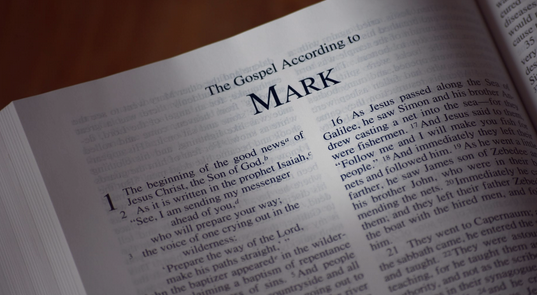
In his Scripture Sketches, J. C. Bailey gave this summary of John Mark’s early failure, and eventual restoration to important ministry.
John Mark started from a good home. He was converted through Peter who seemed to enjoy a special welcome in the house. I wonder who that damsel Rhoda was who could not open the gate for gladness when she heard Peter’s voice without [Acts 12:13], possibly Mark’s sister: and at the very outset of his Christian course, Barnabas and Paul took him with them on their missionary travels [Acts 13:5]. He was Barnabas’s relation and his cousin [Col. 4:10], the bishop, thought himself justified in bestowing his patronage on such a promising young “curate.” Thus early did nepotism enter the church…
This piece of patronage was not eminently successful. The “living” was poor; the income extremely precarious; probably they received more blows than shekels at any time. The two older men were more seasoned, and did not much mind; but the youth was discouraged … John Mark had as yet only that light idea of the responsibility of Christian service which unfortunately is so common: he thought he could take up and put down God’s work as he liked, and he left the two leaders to go on with the work by themselves whilst he went off home again [Acts 13:13].
Then we lose sight of him for six or seven years, which for all we know may have been so much lost time: and after that he becomes the passive cause of an exceedingly unfortunate dispute. Paul and Barnabas—Paul is now taking the lead—arrange a further mission and Barnabas “determines” to take his nephew again with them, whilst Paul “thought not good” to take one who had already deserted his post. This gave rise to “so sharp” “a contention” that the two veterans separate; and Paul goes on with his purposed work, whilst Barnabas takes Mark and goes to Cyprus (his home) [; and again years elapse before we hear anything further of him.
Here again, Mark was seriously to blame, for if he had said that he would not go under any circumstances when he saw the chief apostle objected to taking him, and saw that the matter caused strife, Barnabas could not have prolonged the dispute. However much we may be consoled by the thought that good was brought out of the evil, the quarrel between the two leaders remains an immense calamity [Acts 15:36-40].
Most of us would perhaps have thought it best to leave Mark alone after that; and it comes as quite a surprise that we subsequently find him doing important work in the assemblies, favorably mentioned in some scattered texts, and finally charged with the high honor of writing one of the four Gospels. Not only does Peter (who was his god-father, if I may use that term) take him in hand with that affectionate care which we should expect from one of his nature, but Paul, who had such a disparaging judgment of him in former times, is able to recognize and acknowledge the value of Mark’s subsequent services. He mentions him as being one of his five fellow-workers, who were “a comfort to him“ [Col. 4:10]] in Rome about A.D. 64, and two years subsequently, in his last letter to Timothy, he tells him to “Take Mark, and bring him with thee, for he is profitable to one for the ministry” [2 Tim. 4:11].
This is truly a most delightful verse: the strong-souled, magnanimous apostle accepting and requesting the services of this one whom he had formerly condemned, and going out of his way to acknowledge and praise him, lest anything which he had then said, and said justly, should attach a stigma to one who had now become a devoted and honorable fellow-servant. And on the other hand we see that Mark is so far from remembering Paul’s hard words with any resentment, that he counts it a favor to minister to him and with him. And above all we see that ours is not a hard Master. He doth not cast off forever.
If we, like Mark, have failed and failed grievously in the past, there may yet be opportunity in the present and future for us, like him, to hope, to dare, to accomplish great services, and to “Let the dead past bury its dead.”
https://bibletruthpublishers.com/scripture-sketches-14-john-mark/j-c-bayley/j-c-bayley/la146245
P.S.
“being confident of this very thing, that He who has begun a good work in you will complete it until the day of Jesus Christ…” Philippians 1:6
“For a righteous man may fall seven times And rise again…” Proverbs 24:16
Peter’s restoration to ministry
Peter denied the Lord three times, as predicted] “And Peter remembered the word of Jesus who had said to him, ‘Before the rooster crows, you will deny Me three times.’ So he went out and wept bitterly.” Matthew 26:75
“The Lord is risen indeed, and has appeared to Simon!” Luke 24:34
“He [Jesus] said to him the third time, ‘Simon, son of Jonah, do you love Me?’ Peter was grieved because He said to him the third time, ‘Do you love Me?’
And he said to Him, ‘Lord, You know all things; You know that I love You.’
Jesus said to him, ‘Feed My sheep.'” John 21:17. See Acts chs 1-11
JBW
 Revitalizing Pastors