Chaplaincy and Congregational Care


Pastor, do you ever feel overwhelmed by the responsibilities of pastoral care of the church members and their families? We remember Moses’ workload and the counsel of his father-in-law Jethro:

“And so it was, on the next day, that Moses sat to judge the people; and the people stood before Moses from morning until evening. So when Moses’ father-in-law saw all that he did for the people, he said, “What is this thing that you are doing for the people? Why do you alone sit, and all the people stand before you from morning until evening?”
And Moses said to his father-in-law, ‘Because the people come to me to inquire of God. When they have a difficulty, they come to me, and I judge between one and another; and I make known the statutes of God and His laws.’
So Moses’ father-in-law said to him, ‘The thing that you do is not good. Both you and these people who are with you will surely wear yourselves out. For this thing is too much for you; you are not able to perform it by yourself. Listen now to my voice; I will give you counsel, and God will be with you: Stand before God for the people, so that you may bring the difficulties to God. And you shall teach them the statutes and the laws, and show them the way in which they must walk and the work they must do. Moreover you shall select from all the people able men, such as fear God, men of truth, hating covetousness…'” [and delegate most of the judging to them]. Exodus 18:13-21.

But how can we delegate a significant portion of this congregational care load? One program that focuses on this need is Stephen Ministries.

Another option is chaplaincy. Although chaplains usually serve in the community, they can also serve in the area of pastoral care in the church. The International Fellowship of Chaplains addresses this opportunity:

“Church Chaplains minister within and alongside the local church. As in every community, people struggle with difficulties. Within a church community, people often struggle in silence, hesitating to bother others with their troubles. Chaplains assist the pastoral staff with emotional and spiritual care, crisis, and interventions within the body. This ministry of presence from Chaplains promotes stability of soul, strength of spirit, and quality of well-being for church members.
What does a Church Chaplain do?
Chaplains work under the authority of the church pastor(s) to provide assistance in caring for, and serving, members of the congregation. The scope of their work is determined by their church leadership.
Chaplains meet people where they are and provide comfort and relief at the moment they need it most through emotional and spiritual care when people are traumatized or struggling with grief and loss, depression, thoughts of suicide, or secrecy of domestic violence.
Chaplains may also visit church or family members in the hospital, nursing home, and under hospice care.”

Let’s recognize the importance of equipping the saints for the work of ministry (Eph. 4:12), including the ministry of congregational care.

Here is a chaplaincy brochure and an introductory video from IFOC.org.

Identity and Ministry

In my early years was a pastor in Canada I found that my church role was becoming my source of identity. Although being a pastor is a noble ministry, it should not be our essential identity.

We live in a way that corresponds with our perceived identity…for better or worse. However, even when our identity is positive, if it is based on our circumstances and performance it will be an insecure identity. The Christian life should be lived as “being in order to do.” In other words, our ministry should flow from our grace-based identity. Note the order in Ephesians 2:10 (Amplified translation):

“For we are His workmanship [His own master work, a work of art], created in Christ Jesus [reborn from above—spiritually transformed, renewed, ready to be used] for good works, which God prepared [for us] beforehand [taking paths which He set], so that we would walk in them [living the good life which He prearranged and made ready for us].”

Steve Prokopchak has written a helpful book on this subject: Identity: The Distinctiveness of You.

“…Everyone is searching for security, significance, and identity—it’s a human quest. We gravitate toward finding security and identity in our job, education, relationships, money, talents, or things. These may all miss the mark about who we are created to be. They provide meaning to life but are shortsighted in defining our true identity.

“You will find a clear process of discovering your destiny through discovering your identity. You will also read about the trap of emotional dependency, the prison of self, sexual brokenness, healing damaged identity, and building identity in the heart of a child.”

This helpful book is available in print and audio formats. store.dcfi.org/product/identity-the-distinctiveness-of-you/

Consider doing a study of Ephesians chapters 1-3 and list the many encouraging terms that describe our identity in Christ— an identity that is based on our new spiritual birth.

J.B.W.

Here is a video of Steve Prokopchak teaching on this theme.

Prayer Stations Outreach

People need to be saved and Jesus Christ is the only answer. The Prayer Station ministry is dedicated to providing an effective way to reach people with the saving knowledge of Jesus Christ using five little words…“May I Pray For You?”

Learn more about this amazing street evangelism tool and how it could be used of the Lord to make a difference in YOUR community!

You can download the introductory notebook at
www.prayerstations.org/pastor

Keep Looking in the Right Direction

There are so many issues and influences that make it difficult for the pastor to maintain the right focus. It reminds us of Peter’s experience on the Sea of Galilee:

“So He [Jesus] said, ‘Come.’ And when Peter had come down out of the boat, he walked on the water to go to Jesus. But when he saw that the wind was boisterous, he was afraid; and beginning to sink he cried out, saying, “Lord, save me!” And immediately Jesus stretched out His hand and caught him, and said to him, “O you of little faith, why did you doubt?” (Matt. 14:29-31).

In The Christian Minister’s Manual, Guthrie Veech summarizes the focus of Christian ministry with these eight guidelines:

1. Focus your ministry, first and foremost, on Christ (Ephesians 4:15).

2. Focus your ministry on love (1 Thessalonians 3:12).

3. Focus your ministry on the Word of God (1Peter 2:2,3).

4. Focus your ministry on your own growth (2 Peter 1:5-8).

5. Focus your ministry on grace and knowledge (2 Peter 3:18).

6. Focus your ministry on faithfulness (2 Corinthians 9:10).

7. Focus your ministry on lost people in your community and around
the world (Matthew 28:18-20).

8. Focus your ministry on prayer (Colossians 4:2).*

Perhaps we could consider the primary focus to be on God through Christ by the Holy Spirit, with the other seven resting on this foundation.

The apostle Paul gave this grace perspective: “Now the Lord is the Spirit; and where the Spirit of the Lord is, there is liberty. But we all, with unveiled face, beholding as in a mirror the glory of the Lord, are being transformed into the same image from glory to glory, just as by the Spirit of the Lord” (2 Cor. 3:18,18).

The author of Hebrews admonishes us to keep “Looking unto Jesus, the author and finisher of our faith…” (Heb. 12:2).

May we have faith to maintain the right focus, rather than being distracted by the wind and waves of opinions, emotions, and trends.


*The Christian Minister’s Manual, Guthrie Veech (Standard Publishing, 2012), 15-17.


Boasting in The Cross of Our Lord Jesus Christ: A Testimony

by Ds. PIET DU TOIT
CAPE TOWN, SOUTH AFRICA
“But God forbid that I should boast except in the cross of our Lord Jesus Christ, by whom the world has been crucified to me, and I to the world” (Gal. 6:14).
The glory of the full revelation of the Cross of our Lord Jesus Christ has had an enormous impact on my life and upon my ministry. Looking back in reflection, I can confidently say that my life is clearly divided into two distinct phases of “before the Cross” and “after the Cross”.
Notwithstanding seven years of theological training which culminated in my being ordained as a full fledged Minister of Religion, I realize, looking back, that I still had a very scant understanding of the deeper work of the Cross. Quite frankly, I had no real comprehension of what actually happened to Jesus on that Cross and even less of an idea of what had happened to me, because of this Cross.
As a result I lived my life in constant striving to “do” in order to “be”. I lived out of the experience of my past and out of my own perception of “who I am” and busied myself zealously in trying to do everything I could to make myself acceptable in a “work program religion”. What I did and my proficiency in doing it, thus became of utmost importance to me. This drove me to endless striving towards building my own little kingdom around myself based on the intensity and vigor of my zeal and performance.
Around that time, it started to become apparent to me that there was no real power in my preaching and no sense of victory in my personal life. I began to earnestly wrestle with my own ‘flesh’ and the sins of the ‘flesh’ which made me feel that, although saved, I was yet still a sinner. I concluded that since I seemed to have had no victory over sin, I therefore needed to work harder to overcome it.
When this course of action failed to bring the results I sought, I began to experience enormous frustration in my inner being. I felt defeated and incompetent and unable to help the very people I was supposed to be ministering to. If I couldn’t even help myself, how could I possibly help others, was the uppermost thought in my mind. I felt a failure and that I lacked worthiness and didn’t belong. My ministry began to waiver and then fell in ruins. I found myself cornered in a dead-end street.
Then I made a wonderful discovery. I discovered that this was actually the best place for me to be in. It dawned on me that I was right in the centre of a ‘desert experience’ where the “self-life” is reduced to an absolute “nil” as I literally ‘came to the end of myself’. It was right there, in this ‘desert experience’ that my spiritual bankruptcy was revealed to me; and, for the first time in my life, I began to hear God’s voice as He came to meet with me in that place, just where I was and just as I was.
It was there in that desert place that I could see for the first time that God, by His Grace, His Love and His Mercy, had ‘brought me out of the captivity of Egypt’ (the ‘Adamic’ bloodline), had saved me through the ‘Red Sea’ of Salvation, had overcome my enemy and had reconciled me back to Himself, ‘in Christ’, through the Cross of Calvary (Col. 1:19-22; 2 Cor. 5:19,20; Rom. 5:10; Eph. 2:16). Thus, I arrived at that blessed point of my life where I had come to ‘the end of myself’ and was prepared to ‘deny “MY-SELF”, take up my Cross daily and follow Jesus’ (Luke 9:23).
I began to understand the true meaning of this Scripture and saw that I needed daily to deny the “self-life” any power, and that ‘taking up my cross daily’ meant that “Christ has died for me, and I have died with Him”. I finally comprehended that great and wonderful mystery that I did not have to ‘work’ or strive to ‘do’ anything, because Christ had already prepared it and done it for me. This brought me to that blessed place of understanding experientially that, as I surrendered and got ‘myself’ out of the way, so Christ would come in and take over and live ‘His life’ in and through me. I had finally ‘exchanged’ my life for His life. At last I lived as a new creation, ‘born again’ from above.
This life changing discovery was the beginning of an exhilarating journey—which continues even today—has lost none of its excitement. Heavenly Father has during this time blessed me by unveiling the Cross piece by piece and by revealing to my understanding truth after truth and mystery after mystery concerning the deeper work of the Cross.
An excerpt From Pastors to Pastors: Testimonies of Revitalized Ministries, edited by Charles R. Solomon (Grace Fellowship International: 2010).

Chronological Bible Storying

Last August my associate, Mark, and I were in South Africa on a ministry trip. While visiting a sister with a heart for discipleship, we discovered that she had been reached and discipled through Calvary Road Ministries in Kenya and Uganda. Mark and I also have had connections with CRM and were were reminded of the strategic value of chronological Bible storying for evangelism.

Several Ministries have developing strategic resources for Worldview Evangelism & Discipleship through Bible stories presented orally and in chronological order. Here are four leading examples of this.

1. Calvary Road Ministries
https://www.calvaryroadministries.org/resources

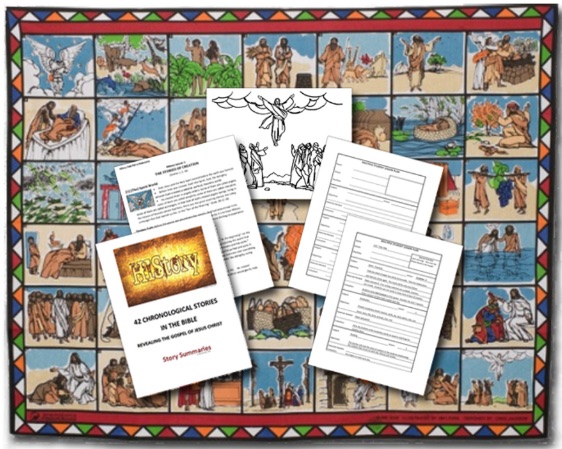
Sample resource: The Story Cloth

“Did you know that 80% of the world are oral communicators by necessity or preference? Oral learners can be completely or functionally illiterate; visually or hearing impaired; part of an oral culture; or simply prefer to learn in an oral manner. There are more than 6 billion oral learners in the world, and of that group over half of them are children!

The Bible Storying Cloth Scarf is a wonderful tool to communicate the message of Christ to oral learners in a way that makes sense to them. This colorful storying cloth has 42 squares vividly illustrating stories from creation to Christ. A page of scripture references is included that corresponds with each of the squares on the cloth. Display the storying cloth on a wall for missions events or use it for Bible teaching lessons.” (with free downloadable teaching aids)

2. Ethonos 360
ethnos360.org

Sample resource: Firm Foundations, by Trevor McIlwain

“The gospel and grace are simple concepts. Communicating them clearly is not. Especially in a culture where concepts like ‘sin’ and ‘holiness’ and even ‘truth’ are negotiable and redefining God to fit our desires is almost fashionable.People around the world have used an effective solution: teaching chronologically through the Bible.”
https://biblestudy.ethnos360.org/

3. Good Seed
GoodSeed.com

Sample resource: The Stranger on the Road to Emmaus, by John Cross

“When you think of God, what is he like? How you answer that question reflects your worldview. Each of the major worldviews are different, and GoodSeed has created resources designed for each worldview, whether Christian, Islamic, Eastern religious, or Secular.”

“GoodSeed has developed a variety of resources that churches can use in both evangelism and discipleship. These resources are useful for:

  • grounding each of your congregants so they have a solid understanding of the gospel. (Remember: a clear presentation of the gospel flows out of an accurate understanding of the gospel.)
  • ensuring each congregant is confident on how to share the gospel message.
    preparing your church to be ready at all times to share the gospel with visitors and newcomers.
  • getting your church to actively reach into its community with the gospel message.” https://goodseed.com/train-your-church.html#guiding

4. Good Soil
GoodSoil.com

Sample resource: The Story of Hope Workbook

“A time-flexible resource for presenting the Bible’s big redemptive story in as few as fifteen minutes or as long as twenty or more hours. Designed for evangelistic Bible studies, one-on-one or in small groups, but also helpful in teaching God’s redemptive plan to believers. Includes a study of 40 Bible events (20 Old Testament and 20 New Testament) and Bible maps. 64 pages and plastic coil binding. FREE Leader’s Guide and FREE Classroom Facilitator Guide available as downloads from this site.” https://www.goodsoil.com/resources/

May we as ministry leaders discover the value of this approach for biblical evangelism and discipleship in a secular culture.

JBW

Intercede for Christian Leaders

“Finally, brethren, pray for us, that the word of the Lord may run swiftly and be glorified, just as it is with you.” ( 2 Thess. 3:1).

“Continue earnestly in prayer, being vigilant in it with thanksgiving; meanwhile praying also for us, that God would open to us a door for the word, to speak the mystery of Christ, for which I am also in chains that I may make it manifest, as I ought to speak.” (Col 4:2-4).

Andrew Murray observed, “These verses suggest the strength of Paul’s conviction that Christians had power with God. Their prayer will bring new strength to him and his work … If Paul, after having preached for 20 years in the power of God, still needed the prayer of the church, how much more does the minister in our day need it?… Let us all intercede more faithfully for ministers, whether of our own church or of other churches.”

Daniel Henderson’s team is preparing a resource to equip intercessors:

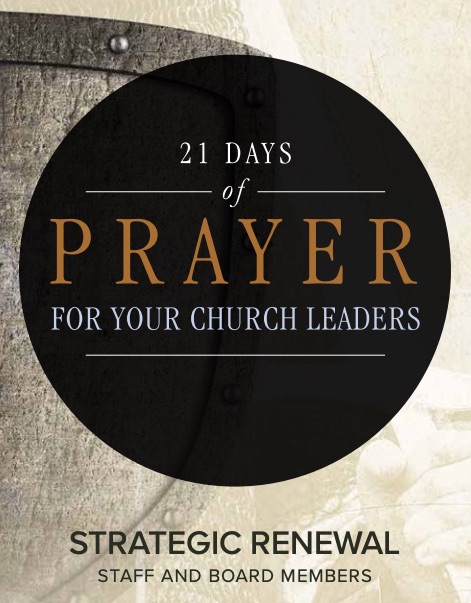
“The staff and board of Strategic Renewal have worked together to compile a resource that will help you pray for the church leaders in your life. Our book 21 days of Prayer for Your Church Leaders: Lifting Up a Shield of Intercession will inspire you to stand in the gap for those who God has appointed to lead you. In anticipation of the arrival of this resource, we have prepared a preview PDF that includes 7 chapters of the book. Look for the complete book around the new year!”

Click here to access this sample: 21 Days of Prayer

May we pray for ministry leaders more intentionally.

The Positively Responsive Life

“Now may the God of peace Himself sanctify you completely; and may your whole spirit, soul, and body be preserved blameless at the coming of our Lord Jesus Christ. He who calls you is faithful, who also will do it.” 1 Thessalonians 5:23,24

Verse 24 holds they key to preaching that has a grace orientation rather than works orientation. Most preaching is an exhortation to try to live the Christian life rather than the New Covenant perspective of God’s Spirit living in and through the believer (Eph. 5:18; John 15:1-8).

This sermon is a brief expository message on 1 Thessalonians 5:16-24: “Living a Positively Responsive Life.”
by John Woodward
For Worcester United Church in South Africa

Preaching an Old Testament Text to Include New Covenant Meaning and Applications

Subject of this study: progressive revelation as exemplified in preaching this text:

“These six things the LORD hates, Yes, seven are an abomination to Him: A proud look, A lying tongue, Hands that shed innocent blood, A heart that devises wicked plans, Feet that are swift in running to evil, A false witness who speaks lies, And one who sows discord among brethren.” Proverbs‬ ‭6:16-19‬ ‭NKJV‬‬

In Proverbs. This text is a memorable, poetic list of sins/ vices described in terms of vivid physical actions. 

In O. T. law. God’s righteous laws condemn vices for individuals and society. The Mosaic covenant contains providential blessings and cursing based on corporate conduct. 

In O. T. history. History includes examples of these vises and the tragic consequences that follow (and positive examples of the opposite characteristics.)

In O. T.  prophecy. The prophets rebuke vices as violations of God’s moral standards, especially sin patterns that were forbidden in the Mosaic covenant. 

In N. T.  Gospels.  Jesus is the perfect example, avoiding every vice and demonstrating righteous conduct. His teaching and preaching raised the standards of morality to a higher level, especially superseding the oral traditions and hypocritical conduct of the legalistic sects of the Jews.

Christ’s sacrificial death and bodily resurrection provided atonement so the repentant sinner could be saved, forgiven and reconciled to God. 

In The Acts of the Apostles. The Holy Spirit baptizes believers into the Body of Christ and helps them live righteously. 

In the N. T.  Epistles. Through identification with Christs’s death and resurrection, the believer experiences a new identity (saint), a new regenerated spirit (with a new righteous nature), is free from sin’s authority, is free from the law, and is invited to abide in Christ. He is to daily trust in Christ to live in him and through him by grace through faith. This quality of life displaces vices by bearing the fruit of the Holy Spirit (Gal. 5:22,23). Exhortations to put off vices and cultivate righteous character and actions flow from the graciously bestowed blessings of the New Covenant. Instead of walking after the flesh (which would produce vices such as those listed in the Proverbs text), the believer is called to Intentional, ongoing submission and obedience to the indwelling Holy Spirit, bearing the fruits of practical righteousness (Eph. 5:18; Gal. 5:17; Rom. 6:3-14). 

Pastor, are you preaching God’s Word in light of the full revelation of the New Covenant? Don’t settle for a history lesson that could be taught in a synagogue, or a morality lesson that would not teach beyond a liberal theologian’s homily. As the angel exhorted the apostles, “Go, … and speak to the people all the words of this life.” (Acts 5:20).

-John Woodward

Sent from my iPhone

Cameroon Baptist Convention

The annual Ministers’ Conference of the Cameroon Baptist Convention was held in Limbe, Cameroon August 16-18, 2023. The plenary sermons were preached by Dr. John Woodward: 

Matthew 25:21,23: “Well done, good and faithful servant…”
Convention 2023 Text: 1 Timothy 4:15,16:

“Meditate on these things; give yourself entirely to them, that your progress may be evident to all. Take heed to yourself and to the doctrine. Continue in them, for in doing this you will save both yourself and those who hear you.”

Here are the two sermon outlines:

He also gave two workshops on Christ-centered pastoral counseling. See GraceStudyHall.org

  • John Singinie came from Malawi, gave testimonies and presented a Workshop on Dynamic Discipling. See DCImalawi.com and DynamicChurches.org under “Traning Resources.”

You are invited to study these outlines and discover GFI and DCI resources