Dealing with Stressors in Pastoral Ministry


One of the big challenges of pastoral ministry is dealing with being criticized…especially by members of the congregation you serve. In an article on this topic, Craig Cable observed:
“I recently had candid conversations with two wonderful friends in ministry regarding a pastor’s need for thick skin. During one of these conversations, my associate pastor friend shared that a disgruntled church member recently sent the senior pastor an absolutely scathing letter via registered mail. This unorthodox method of delivery ensured that the pastor would read and feel every toxic word that was spewed out on paper. I thought, ‘What infraction could possibly warrant a nasty letter like that?’
“My second conversation was with the wife of a pastor. She told me that they’re constantly receiving criticism from outspoken parishioners. In spite of their best efforts, someone is always going to be upset and she and her husband were always going to hear about it. With a trembling voice and tears in her eyes, she confided that they’re often left wondering if they can do anything right. I can only imagine how daunting and discouraging that must feel week after week, year after year.
It doesn’t escape me that pastors are under immense pressure. Aside from pouring their lives into helping children, youth, and adults grow in their relationships with Jesus, they’re also the lightning rod for everyone’s frustrations. They have to be compassionate and grace-filled in the face of adversity, scrutiny, and challenge…”
https://refreshthechurch.com/piercing-the-pastors-thick-skin
As Christian leaders we can find consolation through God’s acceptance and the indwelling life of Christ. The Chief Shepherd can provide an “equilibrium” to His undersheperds and their families:
We need to value our relationship with God more than the opinions of others. People can be so fickle! Remember how the people of Jerusalem hailed the Lord Jesus with praise on Palm Sunday, yet a mob in the same city cried “crucify Him!” only five days later! And Acts tells of the people of Lystra who wanted to worship Paul and Barnabas after the miraculous healing of a crippled man, yet ended up stoning Paul when his enemies from a neighboring city arrived (Acts 14:14-20). The opinions of others are like shifting sands, so don’t use them to calculate your worth!
The abiding life gives the disciple of Christ an inner equilibrium than can stabilize him/her from the effects of vain flattery as well as the effects of negative criticism. How reassuring that in Christ we are “accepted in the Beloved One” with “no condemnation” and the promise that “all things work together for good to those who love God and are called according to His purpose” (Eph. 1:6; Rom. 8:1,28).
When criticized by opponents in Corinth (a church God used him to plant), Paul responded:
“But with me it is a very small thing that I should be judged by you or by a human court. In fact, I do not even judge myself. For I know nothing against myself, yet I am not justified by this; but He who judges me is the Lord. Therefore judge nothing before the time, until the Lord comes, who will both bring to light the hidden things of darkness and reveal the counsels of the hearts. Then each one’s praise will come from God” (1 Cor. 4:2-5).
You find inner security by looking to Christ to meet your ultimate needs.
“If God is for us, who can be against us? He who did not spare His own Son, but delivered Him up for us all, how shall He not with Him also freely give us all things? Who shall bring a charge against God’s elect? It is God who justifies. Who is he who condemns? It is Christ who died, and furthermore is also risen, who is even at the right hand of God, who also makes intercession for us” (Rom. 8:31-34).
So when complements come your way, lay them at the feet of the Champion of our salvation. And when “brickbats” of harsh criticism come sailing through the air, catch ’em and assemble an altar of praise to our God.
May we appropriate grace to keep our balance when criticisms come.
J.B.W.
Read the full article here: https://gracenotebook.com/bouquets-and-brickbats/

Living on the Edge reports: “Pastors all over the world are struggling. Many are burned out and beaten down. It really started during the pandemic but the immense issues of our day weigh heavily on pastors. A record number have quit and others are on the verge of throwing in the towel.
“During the pandemic, we created a resource for pastors called The A.R.T. of Survival. It is a teaching out of James 1 about persevering. We were initially able to train over 10,000 pastors in 60 countries using Zoom and the response was overwhelmingly positive. https://livingontheedge.org/daily-discipleship-2/In this 10-Day Challenge in James 1, Chip takes just 10 minutes a day to help you learn The A.R.T. of Survival. The gospel promises victory, not victimhood, but sometimes in this broken world it feels like we can barely survive, let alone thrive!
Begin this free course here: livingontheedge.org/daily-discipleship-2/
LIVING IN THE HOPE OF AN ACTS 6:7 AWAKENING
AN INTERNATIONAL GATHERING!
Join Hundreds of Ministry Leaders From All Over the World!
When: May 30th – June 1st, 2023
Where: Centre Street Church in Calgary, AlbertaCANADA
“This will be a time of powerful plenary presentations, life-giving corporate prayer, and practical workshops to rejuvenate, inspire, and awaken your passion for Jesus Christ and His mission!”
There is an option to register to view the sessions live streamed.

A Pastor’s Testimony
by Jeff Black
Words cannot describe the way that I felt. I was tired of trying, tired of doing, and tired of being a believer. I was saved at the age of 19, baptized immediately, and put to work in just a few weeks teaching teenagers. Only by God’s grace did things get accomplished. I was new and green, and the church I was attending at that time was in need of a youth leader. I had energy and all kinds of ideas, and they were happy and relieved to turn it over to me. In those two, short years, my wife (girlfriend at the time) and I became workers with a great desire to do whatever was necessary to make sure all were pleased; and most importantly, we wanted our Lord to be pleased.
After my wife, Tonja, and I were married, we moved from that church to the present one; and we never skipped a beat. When the Pastor found out that I loved teenagers and had worked with them for two years, he asked me to consider working with them. Being the person that I was, needing to feel important and needing the security that I got from pleasing others, I accepted. At this time, I was working construction, going to Bible College, and looking to start a new work for God. This was the beginning of a long, grueling journey to try to please God so I could have the security that I desired.
As a child I was always insecure. I had a fear of not being accepted; and, as a result, I felt rejected a lot. Although my parents were good parents, and they loved me very much, I was still insecure. As a result of that fear, I tried to work hard to please all who asked something of me. Surely if I produced for enough people, someone would accept me. I continued on with my job, school, and working with the teens; but still there was an empty spot inside of me. So being the good, fundamentalist that I was, (and that I was expected to be), I started working every week in the junior churches. Right after that God called me to preach.
Now the pressure was on to its fullest extent, or so I thought. One day at work, I got a phone call; and my wife said, “Hi Daddy.” Now what was I going to do? The construction job was starting to play out; doing the work at church was really stressing me; God was calling me, and now I was going to be a daddy. I did the only thing that I knew to do—run from the calling of God, bow my neck and try working harder for Him; surely He would bless me with all of my good effort. The blessing that I was looking for did not come.
I could not understand why the Bible promised me joy and peace, and I could not find it. I knew that God did not lie and that His Word was true; so, obviously the problem was that I was not doing something right and He was not satisfied, so I took on more responsibilities in the church. I did this for 15 years; and believe me, it didn’t get any better. As a matter of fact, it got worse. I felt worse as a believer than I did as a lost person! I started dreading going to church, working in the different ministries and even sometimes questioned whether or not I was truly saved. I read and read the Bible, prayed and prayed for relief; and I could not find any. God seemed like He was a million miles away. I was just sick and tired of trying to please Him. I knew that I couldn’t please my own self. That is why I was trying to please others, but day after day of trying to please God and getting no results or comfort in my soul finally got to me. I just wanted someone, especially God, to be pleased with me; and I could not get the desired results.
I did not understand that God was guiding me to come to Him in surrender. Luke 20:17,19: “And he beheld them, and said, ‘What is this then that is written; The stone which the builders rejected, the same is become the head of the corner? Whosoever shall fall upon that stone shall be broken; but on whomsoever it shall fall, it will grind him to powder.’” Finally (and I praise God for it) after 15 years of trying to be somebody for people to be pleased with, I gave up. I was working for a candy company at this time. I was driving from one city to another, miserable as anyone I have ever known, when I came face-to-face with Christ and His Cross. I was sick and tired of being sick and tired. I pulled off to the side of the road and threw up my hands and prayed this prayer. “God, I am tired; and I am giving up. I can’t do this any longer. I don’t care what you do with me; even take my life if you want to. You can have my wife, my children, my job, my church, my ministries, my health and my wealth. You can even send me to the middle of Africa; I just can’t live under this any longer.”
For the first time in my adult Christian walk I understood what it meant to surrender to what He accomplished for us at the Cross. A burden was lifted off of me and I felt joy. It was almost like I had been saved all over again (in a way I was because I was saved from myself). I did not understand everything that happened to me at that time. I had a lot of unlearning to do. There were, and still are, times when I have to surrender (“die”) daily. I now understand that I am secure in the life that I have which is Christ’s. He is my life and I realize that the old man in Adam that I was trying to satisfy was crucified with Him. Galatians 2:20: “I have been crucified with Christ and I no longer live, but Christ lives in me. The life I live in the body, I live by faith in the Son of God, who loved me and gave himself for me.” I was raised to walk in newness of life. Romans 6:4: “We were therefore buried with him through baptism into death in order that, just as Christ was raised from the dead through the glory of the Father, we too may live a new life.” I can rest now because He is life, my life. Colossians 3:4: “When Christ, who is your life, appears, then you also will appear with him in glory.”
My friends, take a long look at the Cross of Christ; and you will see that He set you free to walk with Him in your new life. No performance is necessary any longer; He took care of it all. My security is in Him; my worth is in Him, and my future is in Him. I don’t have to try to gain acceptance with God any longer through my trying. He is pleased with me already. Why? The answer is because I am in His Son and have His life. All is well within my soul.
Jeff Black serves as lead pastor of First Baptist Church of Proctorville, Ohio.

An exposition and testimony
“I have been crucified with Christ; it is no longer I who live, but Christ lives in me; and the life which I now live in the flesh I live by faith in the Son of God, who loved me and gave Himself for me.” Galatians 2:20 NKJV
Pastor Adrian Rogers’ exposition of Galatians 2:20 included these points. This quality of Christian living is:
1. An executed life
“I have been crucified with Christ…”
2. A exchanged life
“…it is no longer I who live, but Christ lives in me;”
3. An energized life
“and the life which I now live in the flesh I live by faith in the Son of God, who loved me and gave Himself for me.”
Pastor Rogers deduced, “And every demand upon me is a demand upon the Christ, who lives in me, and His faith, not my faith.”
He then recalled the spiritual breakthrough of the wife of pastor Peter Lord. (Adrian and his wife, Joyce, were close friends of Peter and Johnnie Lord in their younger years.)
“Peter Lord’s wife is one of the most godly Christian women I’ve ever known. But Johnnie had a crisis in her life, when all of us were younger preachers…Johnnie came to a place where she almost had a nervous breakdown. The pressures, the demands upon her life—her little children, her husband, studying in seminary, and so forth. I can remember, Johnnie saying, ‘ I tried, and tried, and tried to do right, to live right, to serve God, to be pleasing to God; and, the more I tried, the more I sank…’ And she said, ‘It was terrible. I almost despaired of life, wanting to do right, wanting to be right, wanting to show love. And I would pray, “God, help me to love this person. God, help me to trust. God, help me not to worry. God, help me to believe.”..I was failing, and failing, and asking God to help me…but I was getting no help.’
‘And then,’ she said, ‘I discovered this verse the Scripture: that “I was crucified.” The old person that I used to be is dead, and gone; and now, “Jesus Christ lives in me. And now the life I live, I live by the faith of the Son of God, who loved me and gave Himself for me,” that He might give Himself to me (Galatians 2:20).” And she said, ‘It dawned on me one day, I needed patience. I didn’t pray, “God gave me patience.” She said, ‘I said, “Lord, you live in me – Thy patience, Lord.”‘ And she felt patience, flowing through her. She said, ‘that’s wonderful.’ Then, there was somebody she needed to love; and, very frankly, they weren’t a very lovely person. And she didn’t say, ‘Lord, help me to love them.’ She said ‘I’m going to try it again: ‘”Thy love, Lord,” and she just felt love flowing through her…
Adrian, summarized, “That’s what it’s all about, friend. You see, the life I now live, I live by the faith of the Son of God, and every demand of God that is upon you is not upon you; it is upon Jesus who lives in you. And what liberty that is—what freedom that is—to understand that Christ lives in you.”
An excerpt from his sermon on Galatians 2:20 at www.LWF.org
Adrian Rogers (1931-2005) was a pastor who served three terms as president of the Southern Baptist Convention. He published eighteen books and his works are featured on the radio and television program, Love Worth Finding. He was also the founder of the Adrian Rogers Pastor Training Institute for ministers.
Preaching from the Old Testament (Torah, Prophets and Poetry) is inspired and useful (2 Tim. 3:16), but should be proclaimed in light of the gospel and New Testament revelation. This also holds true for the Gospel’s teaching on righteousness. Even though our Bibles say “New Testament” before the Gospel of Matthew, the New Covenant was not initiated until Christ’s atonement on Calvary.
“And He took bread, gave thanks and broke it, and gave it to them, saying, ‘This is My body which is given for you; do this in remembrance of Me.’ Likewise He also took the cup after supper, saying, “This cup is the new covenant in My blood, which is shed for you” (Luke 22:19,20).
For example, preaching that gives the ethics of the Sermon on the Mount (Matthew 5-7) apart from the revelation of believers being under grace (Rom. 6:14) and indwelt by the Holy Spirit (1 Cor. 6:19) gives the impression of works-based sanctification. In this counter-cultural sermon Christ shows that external righteousness is not adequate to earn eternal life. In John 3:1-18 Jesus teaches the Pharisee Nicodemus that a new birth is required. Former Pharisee, Paul, testified of his salvation experience of receiving graciously imputed righteousness (Phil 3:3-10).
In John 6:63; 15:1-8 Christ explains to disciples the source of expressing this righteousness practically….in light of New Covenant revelation: “I still have many things to say to you, but you cannot bear them now. However, when He, the Spirit of truth, has come, He will guide you into all truth; for He will not speak on His own authority, but whatever He hears He will speak; and He will tell you things to come. He will glorify Me, for He will take of what is Mine and declare it to you” (John 16:12-14).
In other words, sermons on the Old testament and Gospels should include the grace and enablement perspective of the New Testament epistles. Otherwise, listeners will end discovering how “the power of sin is the law” (1 Cor. 15:56).
Just as a non-evangelical pastor gives the impression that good works can be a means of salvation if he does not communicate the gospel of redemption, even so, an evangelical pastor may give the impression that self-effort can successfully live the Christian life if he does not communicate the Gospel of identification (as in Galatians 2:20).
The gospel of identification is explained in the N. T. epistles such as Romans 5:12-8:39. Apart from teaching grace-by-faith sanctification, biblical preaching (whether O. T. or N. T.) comes across as law and the leads to the frustration of Romans 7:21-25: “I find then a law, that evil is present with me, the one who wills to do good. For I delight in the law of God according to the inward man. But I see another law in my members, warring against the law of my mind, and bringing me into captivity to the law of sin which is in my members. O wretched man that I am! Who will deliver me from this body of death?”
The answer of the concluding phrase is I” thank God—through Jesus Christ our Lord!” This answer is explained in iRomans ch. 8, which applies the message of identification with the Lord Jesus as revealed in Romans 5:12-6:23.
Evan Hopkins observed, “How many earnest and religious people belong to ‘the Old Adam Improvement Society.’ It is the recognition of the Christ-life, it is union with the Risen Christ, that men need instead of the culture of the religious self-life.”
May we have the Spirit-filled, grace-oriented N.T. preaching of the apostle Paul, who testified to the church leaders of Ephesus:
“I kept back nothing that was helpful, but proclaimed it to you, and taught you publicly and from house to house, testifying to Jews, and also to Greeks, repentance toward God and faith toward our Lord Jesus Christ. … I have not shunned to declare to you the whole counsel of God. So now, brethren, I commend you to God and to the word of His grace, which is able to build you up and give you an inheritance among all those who are sanctified” (Acts 20:20,21,27,32).
J. B. W.
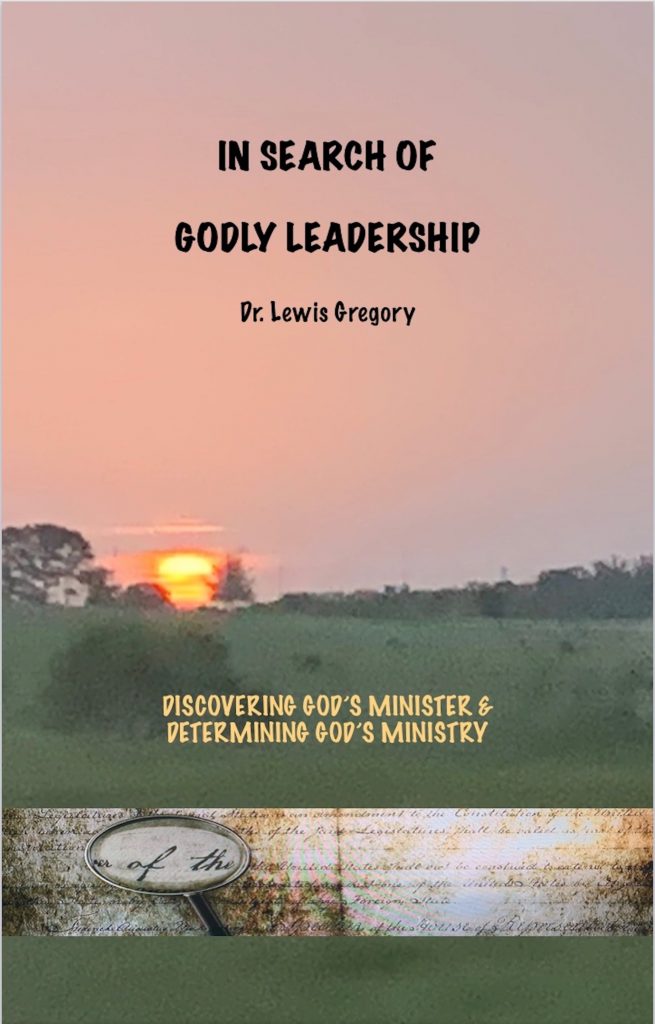
Dr. Lewis Gregory has written a concise book that is valuable for Christian leaders and Pulpit Committees that seeking a pastor for their local church.
There is a leadership void in the world today. So, what can be done about it? God has made ample provision to solve the leadership problem.
Dr Gregory identifies four qualities that are important for New Covenant ministry.
1. This minister is committed to proclaiming the mystery of the gospel, which is “Christ in you” (Colossians 1:27-2:3), Mature ministers of God know their identity in Christ and their ministry calling.
2. This minister understands his own personal identity in Christ and is eager to proclaim it. He should be devoted to showing and sharing the grace of God wherever he goes.
3. This minister is committed to the spiritual growth and maturity of the body of Christ (Colossians 1:28-2:3; Hebrews 6:1).
4. This minister is committed to equipping the saints for the work of the ministry. Ephesians 4:12 gives this mission statement: “for the equipping of the saints for the work of ministry, for the edifying of the body of Christ.” The body of Christ needs someone who build them up in the most holy faith based on the Word of God.
By the grace of God this is possible and vital!
Adapted from Dr. Gregory’s book (pp. 14,15) which can be ordered through his web site here.
https://www.sourceministries.net/go/resources/in-search-of-godly-leadership/

“But to each one of us grace was given according to the measure of Christ’s gift” (Ephesians. 4:7).
British pastor and author, T. Austin-Sparks, emphasized the vital role of God’s grace in salvation, Christian living, and ministry. The references to God’s grace in the Epistle to the Ephesians reminds us as spiritual leaders…
“…It does not matter how far we may advance, into whatever altitudes of spiritual life we may ascend, whatever may be the honour conferred upon us and the service to which we are called, we never for one moment in the slightest degree get beyond the range of grace or beyond the limit where all is of grace…
“There is no more merit in service than there is in salvation, no more merit in spiritual knowledge than in our justification: it is all of grace. I want to emphasise that God must have that ground before He can do things. We have such a way of returning to the Lord and after all seeking to in some way suggest a claim upon Him, a right, a merit, a worthiness, presenting Him ground upon which we feel the Lord ought to do this and ought to do that, and the Lord demands that we shall come for every phase and aspect of our spiritual life and relationship to Him to the place where: “Lord, if You do it, it will be all of grace“; “If the work is done, it will be all of grace.” The Lord demands that ground. You find it through the Old and the New Testaments, the ground upon which the Lord works is, whether we wholly and fully recognise that, whatever the Lord does it will be all His grace, and while in Christ we have privileges and the Lord will sometimes call upon us to lodge a claim to the fulfilment of His promises – after all, on His side it is all of grace. So let us let go to His grace and give Him the ground that He needs for doing His continual enlarging things, and never ourselves become anything as believers or as workers, or as having any knowledge, but holding all things as of the grace of God.” [1]
Austin-Sparks.net is a treasure chest of biblical, spiritual, and ministerial insights. Thanks to a devoted couple in New Zealand:
“Austin-Sparks.Net makes the works of T. Austin-Sparks available in a range of forms. This includes over 350 audio messages in MP3 format, copies of the original A Witness and A Testimony magazines in Searchable PDF format, and republished articles and books. Virtually all of the original messages by T. Austin-Sparks that were published [in] pamphlets and books under the Witness and Testimony Trust are now available in various formats on this website. PDFs are provided for easy printing of articles and books for personal use. E-books in ePub and Mobi formats are available for reading on portable readers from the website as well as from Apple, Kobo and Amazon.”
________________
[1] An excerpt from “Grace” article at Austin-Sparks.Net
“Revival is an infusion of new spiritual life imparted by the Holy Spirit to existing parts of Christ’s body.” -Richard Lovelace
In an interview with Christianbook.com in 1999 Richard Lovelace mentioned four aspects of renewal, symbolized by a baseball diamond.
“The Wesleyan quadrilateral, which is like a baseball diamond, has Scripture as its home plate. The first base is tradition. The second base is reason, and the third base is experience. According to Albert Outler in John Wesley, you had to run around that diamond and keep coming back to Scripture. So, it starts with Scripture, followed by tradition, which is orthodox theology. Then reason, that is applying things to what we know now, and experience—that’s the impact of the Holy Spirit in your life. Finally, you come back to Scripture.
Evangelicals are very strong on Scripture, tradition, and reason. Charismatics and Pentecostals have been real strong on experience, to some degree also on Scripture. They have not been at all involved deeply in tradition, and sometimes don’t make enough use of reason. But what I see coming is a balance of all of this.”
Richard F. Lovelace (Th. D., Princeton), professor emeritus of church history at Gordon-Conwell Theological Seminary, is the author of Homosexuality and the Church,The American Pietism of Cotton Mather, Dynamics of Spiritual Life, and Renewal as A Way of life.