by P. Ángel Manuel Hernández Gutiérrez, www.Misionmoderna.com
By the end of 1999, I was completely exhausted. I had been in Fuerteventura for almost two years—an island that, back then, was very small and deeply identified with Catholic tradition, where preaching the Gospel met with great resistance. I had put into practice everything I had been taught: evangelistic campaigns during the three summer months, street preaching, distributing thousands of tracts, prayer, fasting, and many other initiatives. I describe this entire process in detail in my book What Does God Ask of You? (¿Qué pide Dios de ti?), available on Amazon. However, the physical, emotional, and spiritual toll was so intense that, upon finishing the last evangelistic campaign of 1999, I fainted from psychological exhaustion. I felt I no longer had the strength to go on.
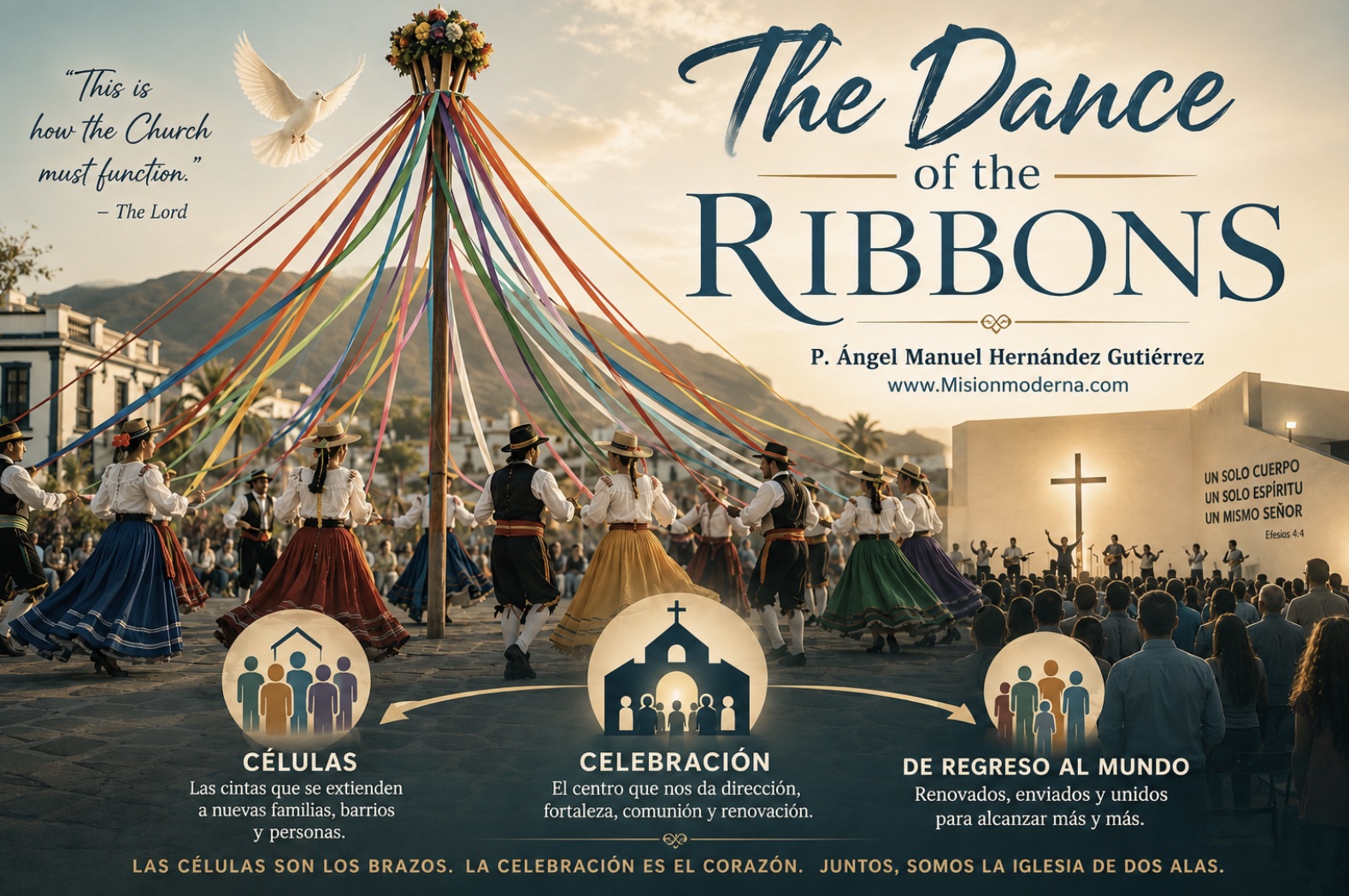
It was that very night when the Holy Spirit woke me up and placed a very clear image in my heart. He reminded me of a traditional dance from the Canary Islands called La Danza de las Cintas (The Dance of the Ribbons). Those who are not from the Canaries might not be familiar with it. In this dance, a group of dancers moves around a central pole while holding long, colorful ribbons. As they move forward, the ribbons extend, cross, and intertwine in a precise order until the pole is completely covered. Then, retracing their steps in the opposite direction, the ribbons unravel and become fully extended once more. The entire process requires coordination, unity, and for each participant to remain faithful to their spot.
As I contemplated that image, the Lord spoke to my heart: “This is how the Church must function.”
I understood that each ribbon represented a cell group reaching out to touch new families, new neighborhoods, and new people. The further the ribbons extend, the greater the reach of the church. Yet, they all return to the same center—the Sunday celebration—where the body receives direction, strength, fellowship, and renewal to go out once again. That day, I grasped a principle that has marked our ministry throughout all these years: cell groups produce growth; the celebration produces strength. Cell groups are the arms of the church, reaching where the temple building cannot; the celebration is the heart, giving unity, identity, and strength to the entire body.
Since we began applying this model, the church has never stopped growing or growing stronger. That small congregation of barely eight people has become, by the grace of God, a church of more than two thousand people integrated into cell groups, welcoming an average of nearly sixty new people every month. Looking back, I am convinced that that moment of exhaustion was not the end of our ministry, but the beginning of a new chapter—one in which God showed us that His work does not grow through the efforts of a few, but through a united body that extends outward and continually returns to its center to receive new strength. In other words: the two-winged church.
Blessings from Above,
Pastor Ángel Manuel Hernández Gutiérrez, Misión Cristiana Moderna
Reposted from https://jcgresources.com/

